
Are you building a Drupal module that already exists? Meet Module Scout

Every Drupal developer has lived this moment. You spend a weekend building a module, post it to the issue queue or drupal.org with some pride, and within a day someone drops a comment: "isn't this basically what X already does?" Sometimes it is. Sometimes it isn't, but you have no way to prove that, because you never actually checked.
It's not laziness. drupal.org's own search is keyword-literal, and Packagist buries Drupal packages under dozens of vendor namespaces. "Just Google it" turns up outdated blog posts more often than it turns up the right module. The Drupal community explicitly asks contributors to check for prior art and document why it doesn't already solve your problem. That's exactly the step that's hardest to do well, so it's the one that gets skipped.
Introducing Module Scout, an AI-assisted sanity check that runs inside your own Drupal site before you write a single line of new code. This module exists to make that research step take thirty seconds instead of an afternoon of half-hearted searching.
Key Takeaways
- Module Scout is a free, Composer-installable Drupal module that checks drupal.org and Packagist for prior art before you build.
- Describe a feature in plain language, and it returns a verdict: build new, extend an existing project, or install one as-is.
- It runs on whichever AI provider your site already has configured through drupal/ai, no separate account needed.
- It generates a ready-to-paste "Similar projects" README section, satisfying the Drupal community's prior-art norm automatically.
- Available now:
composer require drupal/module_scout.
What does Module Scout actually do?
You describe what you want to build, in plain language, the way you'd explain it to a colleague over coffee, not as a string of search keywords. Module Scout takes it from there:
- Extracts concrete search phrases from your description using your site's own AI provider.
- Searches drupal.org's live project directory and Packagist directly, in real time.
- Sends the candidates back to the AI for a real comparison: what each one covers, what gap remains, and whether any of them have a companion or ecosystem sub-module worth using instead of new code.
- Returns a plain verdict: build new, extend an existing project, or just install one as-is, plus a ready-to-paste "Similar projects" README section for whatever you end up shipping.
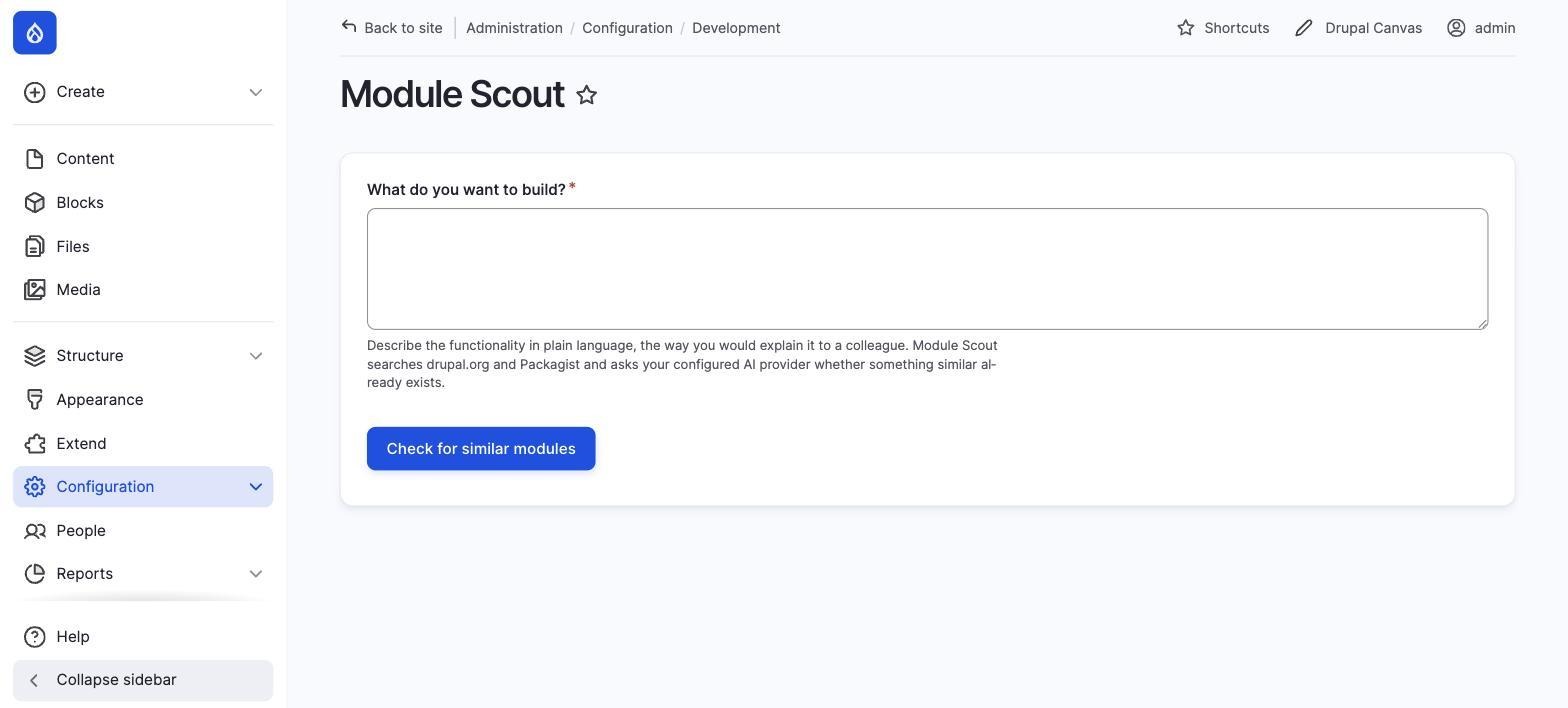
The whole interface is one field: describe what you want to build.
A real example
Here's what happens with an actual, slightly awkward feature request: the kind that's genuinely hard to search for by keyword:
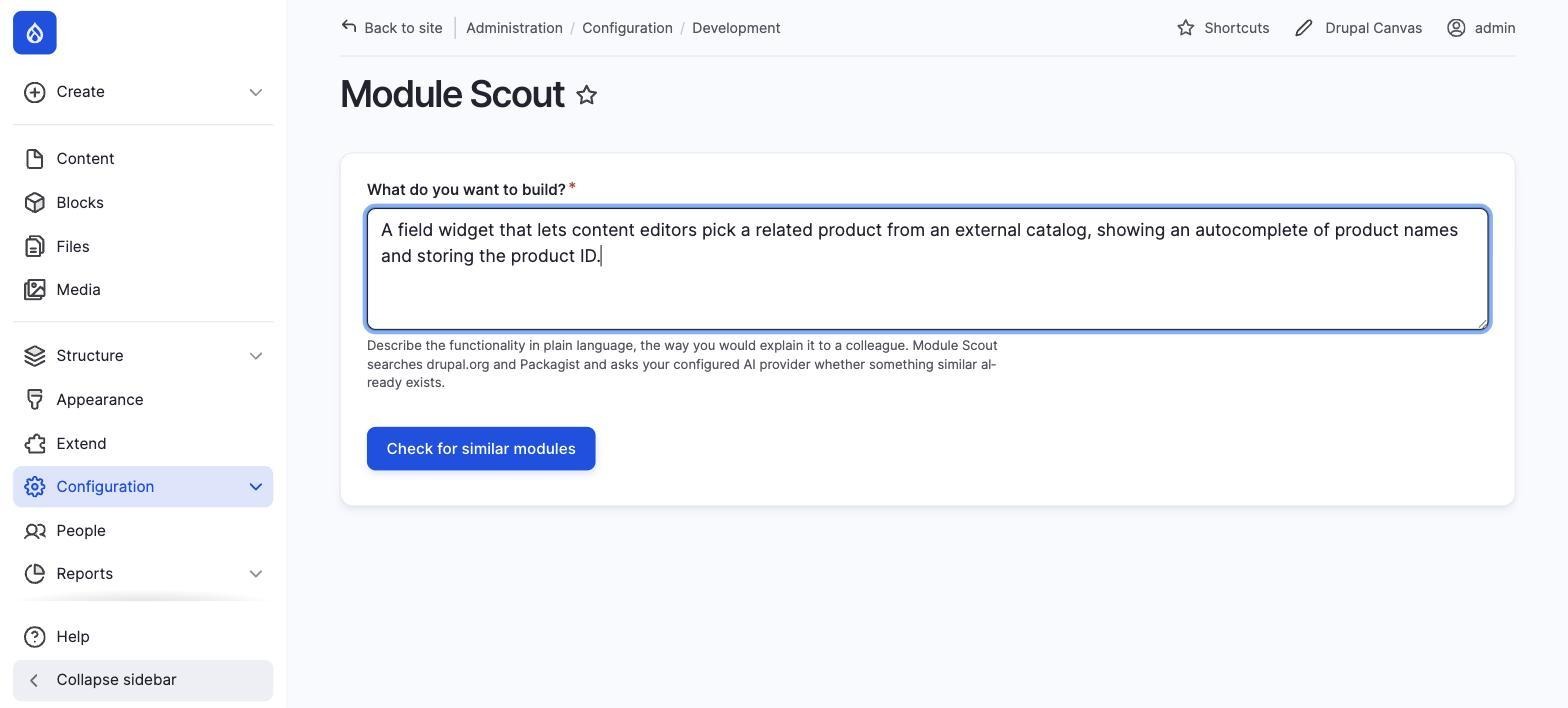
"A field widget that lets content editors pick a related product from an external catalog, showing an autocomplete of product names and storing the product ID."
That's a real request against a real AI provider and real drupal.org/Packagist data. Module Scout comes back with a clear recommendation and its reasoning:
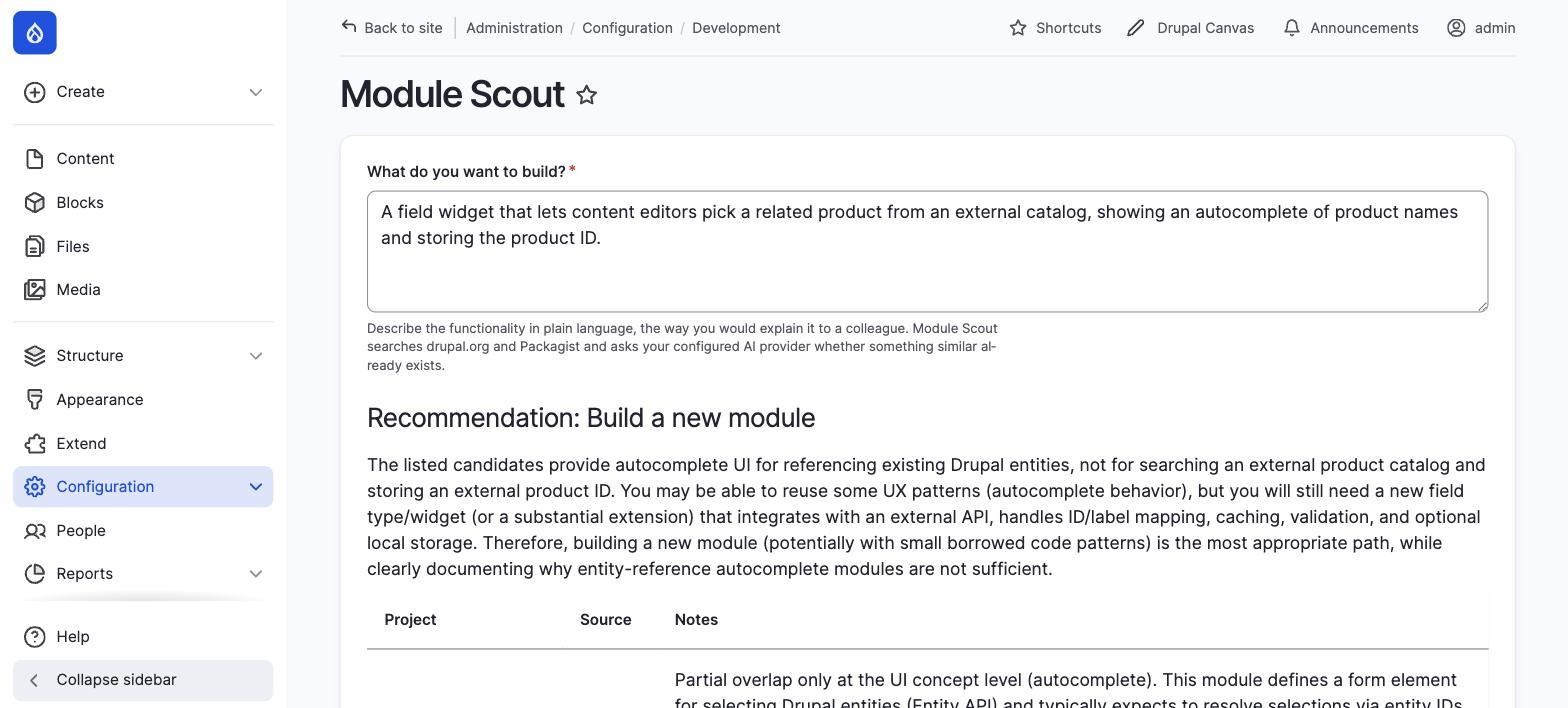
The verdict: build new. Two existing modules come close, but neither quite covers the need.
It names the two closest drupal.org candidates and explains, project by project, exactly where each one falls short of the actual requirement, instead of stopping at a flat "no, nothing exists":
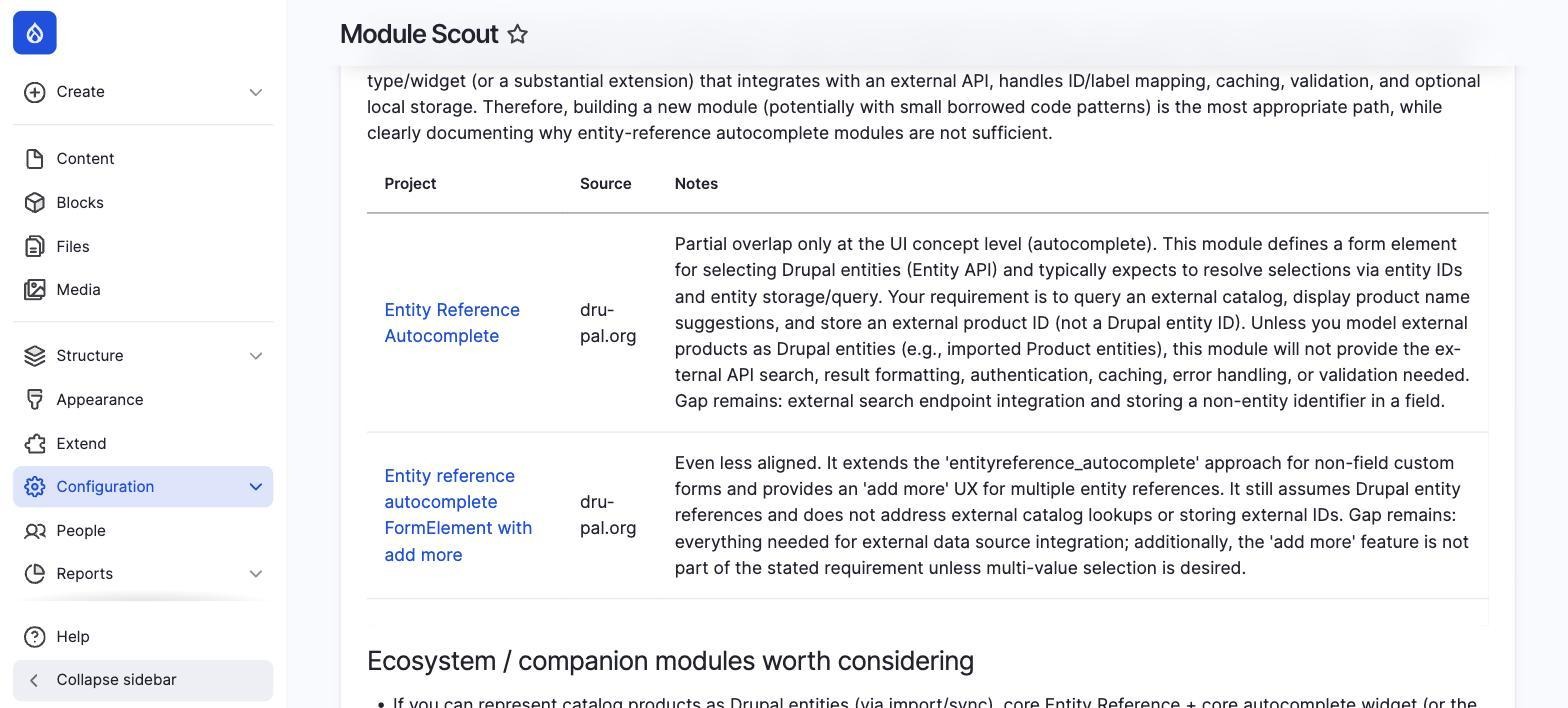
Per-candidate notes: what each module covers, and precisely what gap remains.
The whole point of this exercise is to satisfy a community norm: document why similar projects don't already solve your problem. Module Scout generates that documentation for you, ready to paste straight into your new module's README:
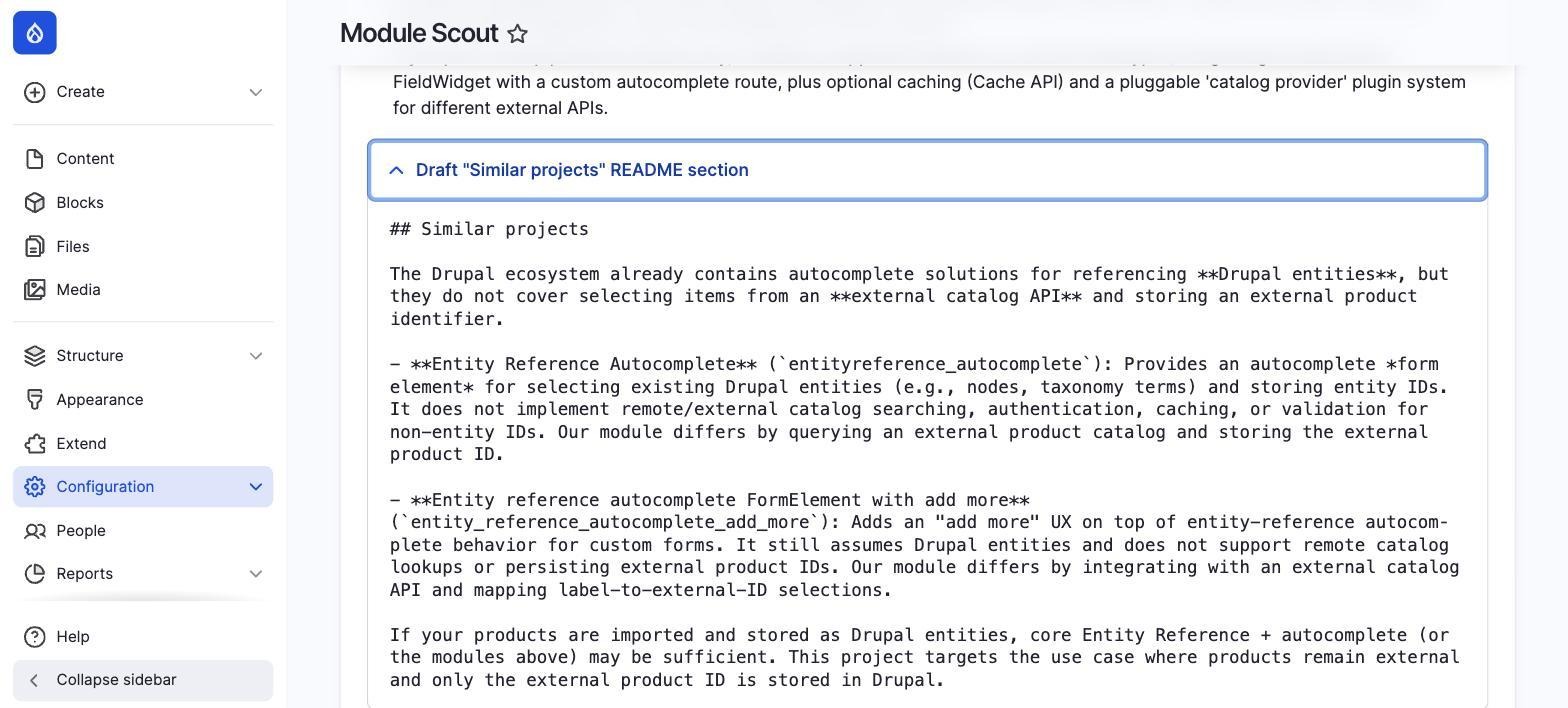
A drop-in "Similar projects" section, written and ready before you've opened an editor.
Why not just use a chatbot for this?
A similar idea already exists as a hosted demo: Drupal Module Finder AI on Drupal Forge. It's a genuinely interesting proof of concept, but it's a separate, login-gated website with its own pre-indexed copy of module metadata. It lives outside your project, as a separate site you visit rather than something you install.
Module Scout is the opposite of that on every axis that matters for a developer's actual workflow:
- It's a real, Composer-installable Drupal module: it lives inside the site you're already building on, not on someone else's server.
- It uses whichever AI provider you've already configured through drupal/ai: OpenAI, Anthropic, Ollama, or any of the 45+ providers the abstraction supports. It uses the credentials you've already set up.
- It queries drupal.org's and Packagist's live APIs directly, every time.
- It ships a Drush command too, for anyone who'd rather stay in the terminal:
drush module-scout:check "..."
drush module-scout:check "a lightweight rating widget for content editors"
Try Module Scout yourself
Getting started takes about a minute if you already have a chat-capable AI provider configured on your site:
composer require drupal/module_scout
drush en module_scout
Then visit Configuration → Development → Module Scout, or just run the Drush command above. If you haven't set up an AI provider yet, Module Scout will point you straight to the AI settings page rather than failing silently.
How is privacy handled?
Your description and short excerpts from any matching drupal.org/Packagist project pages are sent to whichever AI provider your site is configured to use. That's the only data Module Scout handles. It stores nothing itself, contacts no other service, and collects no telemetry of its own. The module's README says this in the same words.
Why does this research step matter?
Drupal's contribution culture has always leaned on a kind of honor system: do the research, check for prior art, document your reasoning. That's still the right norm. Module Scout supports that judgment rather than replacing it, and it has real limits: it's only as good as drupal.org's own metadata, and it can be wrong.
What it does is remove the excuse. The research step that used to take an unmotivated afternoon of half-hearted searching now takes as long as typing one sentence.
If that saves even one contributor from the "wait, doesn't X already do this" comment, it's done its job.
Module Scout is available now on drupal.org/project/module_scout.
Frequently Asked Questions
What is Module Scout for Drupal?
Module Scout is a Composer-installable Drupal module that checks drupal.org and Packagist for existing modules before you build a new one. You describe the feature in plain language, and it returns a verdict: build new, extend an existing project, or install one as-is, along with a ready-to-paste "Similar projects" README section.
How does Module Scout decide whether to recommend building new or reusing a module?
It extracts search phrases from your description using your site's AI provider, searches drupal.org and Packagist live, then sends the closest candidates back to the AI for a project-by-project comparison. The verdict names exactly which gap, if any, keeps existing modules from covering your need.
Which AI providers does Module Scout work with?
Module Scout uses whichever AI provider you've already configured through the drupal/ai module, including OpenAI, Anthropic, Ollama, or any of the 45+ providers that abstraction layer supports. There's no separate account or credential to set up.
Does Module Scout send my code or site data anywhere?
It sends only your typed description and short excerpts from matching drupal.org or Packagist project pages to your configured AI provider. Nothing else leaves your site, and Module Scout adds no telemetry of its own.
How is Module Scout different from the Drupal Module Finder AI demo on Drupal Forge?
Drupal Module Finder AI is a hosted demo: a separate, login-gated site with its own indexed copy of module data. Module Scout installs directly into your Drupal site, uses the AI provider you've already configured, and queries drupal.org and Packagist's live APIs on every search rather than a fixed snapshot.
Can I run Module Scout from the command line?
Yes. The module ships a Drush command, drush module-scout:check "your description here", that returns the same verdict and comparison as the web interface. It's built for developers who'd rather stay in the terminal than open a settings page.
How much does Module Scout cost, and where do I get it?
Module Scout is free and open source, available now at drupal.org/project/module_scout. Install it with composer require drupal/module_scout and enable it with drush en module_scout. The only ongoing cost is whatever your configured AI provider charges for its own API calls.
What happens if I haven't set up an AI provider yet?
Module Scout checks for a configured, chat-capable AI provider before running a search. If none exists, it redirects you to the AI settings page in your Drupal admin, so setup takes one extra step instead of a dead end.
Last updated on September 3, 2026
About the author
Zeeshan Khan
Meet Zeeshan Khan, Sr. Full Stack Drupal Developer, an active Drupal contributor with three Acquia certifications. Zeeshan is fond of cats and dogs and enjoys strumming the guitar. If you ask what’s the best someone could’ve done during the lockdown, Zeeshan nurtured a farm of fruit trees and animals, besides cats and dogs. And if he finds the time out of his work and farm, his favorite travel destination would be Finland.

Getting started with Drupal Canvas: A frontend developer's first look
Wondering why Drupal needs another page builder? Here's what I learned installing Drupal Canvas, exposing my SDCs, and writing React right in the browser.
12 min read


Canvas Page Metatag Module: How to restore full SEO controls to Drupal Canvas pages
Drupal Canvas hides most Metatag fields behind one SEO title box. Check out how Canvas Page Metatag restores them and fixes a Robots checkbox bug.
11 min read


Specbee is now a Drupal AI Initiative Partner. What does it mean for your platform?
Specbee has joined the Drupal AI Initiative as a Certified Partner. See what Drupal AI initiative is about, how it's governed, and what it means for your enterprise site.
5 min read